 Written by
 The Companies That Will Win the Next Decade Won’t Be the Ones That Adapt Faster — But the Ones That Think Differently
Every executive today is navigating pressure.
Artificial intelligence is accelerating faster than governance.
Teams are increasingly diverse across generations, expectations, and values.
Decision cycles are shrinking while risks are expanding.
Markets demand innovation, but organizations are often structured for stability.
Most leadership teams are doing something understandable:
They are managing complexity.
But very few are doing something far more powerful.
They are architecting clarity.
And this difference will define which organizations thrive in the next decade.
The Hidden Problem Inside Many Leadership Teams
When organizations struggle, the issue is rarely a lack of intelligence or effort.
The real issue is how leaders are thinking and responding under pressure.
Under constant complexity, leadership teams often fall into invisible coping patterns:
• Decisions are delayed because uncertainty feels risky
• Conflict is avoided in order to maintain harmony
• Leaders control more instead of enabling others
• Strategy becomes reactive rather than intentional
• Cultural change initiatives stay at surface level
These behaviors are human.
But over time they quietly erode:
- Strategic clarity
- Decision speed
- Innovation capacity
- Leadership credibility
- Organizational trust
What organizations need today is not another leadership seminar.
They need a deeper transformation in how leadership operates.
What True Management Consulting Should Actually Do
Traditional consulting often focuses on solving specific problems.
But the most valuable consulting does something more fundamental:
It elevates the quality of thinking that creates those problems in the first place.
At its highest level, management consulting becomes a partnership that strengthens:
• Strategic thinking
• Leadership alignment
• Organizational culture
• Decision-making discipline
• Responsible technology integration
Instead of delivering recommendations from the outside, it builds the internal capability to lead complexity from within.
And this is where real transformation begins.
Imagine Your Organization 12 Months From Now
Imagine a leadership team that operates with a different level of clarity.
Decisions that once took weeks now happen in days because alignment exists.
Conflict no longer drains energy—it becomes a source of innovation.
Executives no longer react emotionally to pressure.
They respond strategically.
Artificial intelligence is not feared or rushed blindly into adoption.
It is governed with confidence and integrated responsibly.
Teams feel psychological safety, yet accountability remains high.
Generational differences no longer create tension.
They create complementary strengths.
Strategy stops living in presentations and starts shaping everyday behavior.
The organization begins to move with focus, coherence, and momentum.
This is not a theoretical vision.
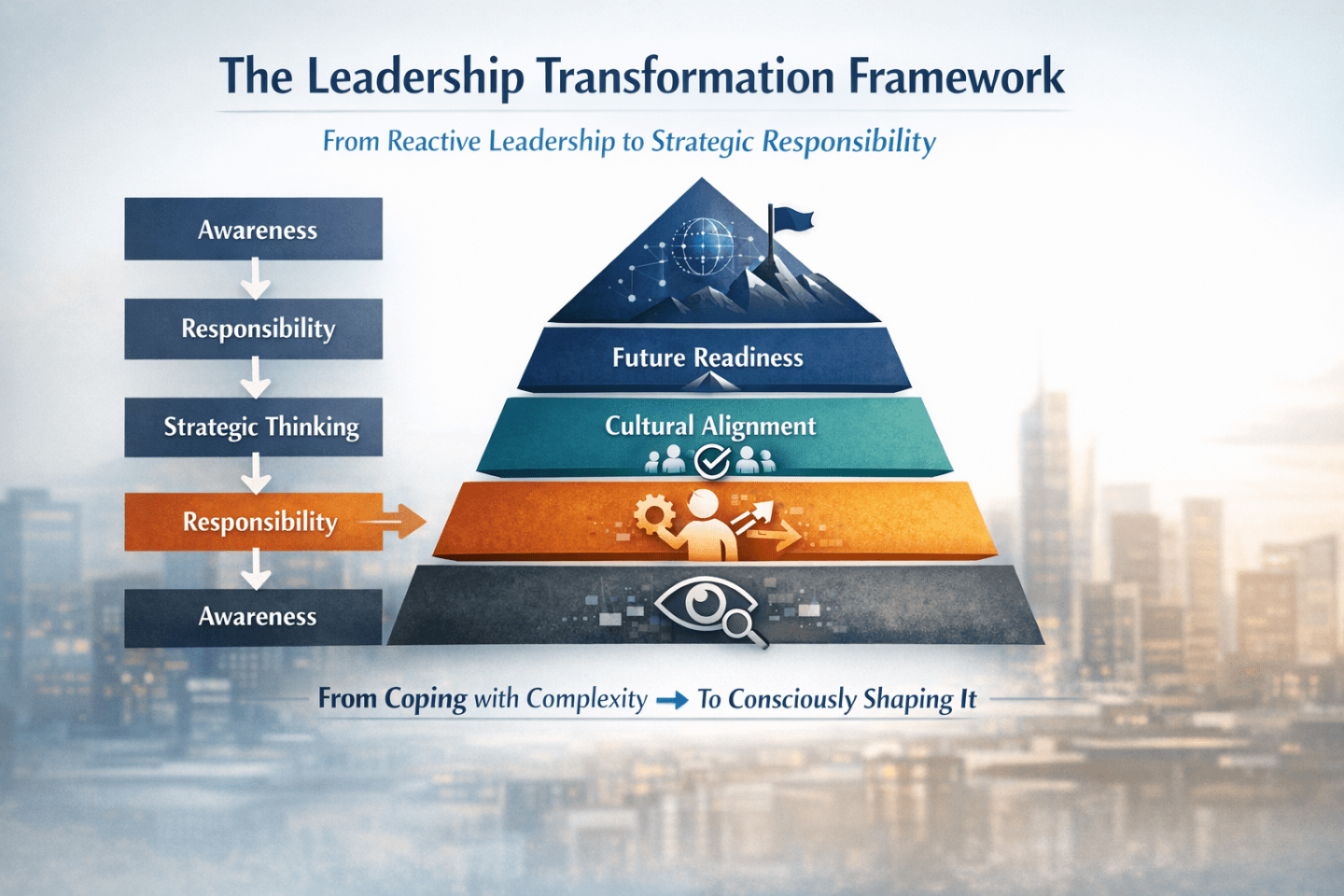
It is what happens when leadership shifts from coping with complexity to taking conscious responsibility for shaping it.
The Core Shift: From Reaction to Responsibility
At the center of leadership transformation is a simple but powerful principle:
Responsibility is the ability to respond intentionally instead of reacting emotionally.
In complex environments, leaders face constant triggers:
Market pressure
Internal conflict
Performance expectations
Technological disruption
Without awareness, those triggers create defensive patterns:
Control
Avoidance
Blame
Over-analysis
Decision paralysis
But when leaders develop the discipline to observe those reactions, something changes.
They gain the freedom to choose a different response.
And that shift transforms the entire organization.
Leadership Transformation Is Not About Learning More
Most executives already know what good leadership looks like.
The challenge is not knowledge.
The challenge is behavior under pressure.
True transformation happens when leadership teams strengthen:
• Emotional regulation under complexity
• Strategic thinking beyond short-term urgency
• Courageous conversations that surface real issues
• Decision-making free from cognitive bias
• Cultural alignment between intention and behavior
When these capabilities evolve together, organizations experience something powerful:
Strategic coherence.
And coherence multiplies performance.
Where Artificial Intelligence Fits Into the Future of Leadership
AI is already reshaping industries.
But the real risk organizations face is not technological.
It is leadership readiness.
Without strong governance, AI adoption creates confusion, fear, and ethical exposure.
But when leaders understand AI strategically, it becomes something else entirely:
A multiplier of human intelligence.
Organizations that succeed with AI build:
• Clear governance frameworks
• Responsible adoption policies
• Cross-functional integration
• Executive-level digital literacy
Technology alone does not create competitive advantage.
Leadership clarity does.
The Results Organizations Experience
When leadership transformation is done deeply and structurally, organizations begin to experience measurable change.
Executives report:
• Faster and more confident decision cycles
• Stronger alignment across leadership teams
• Reduced resistance to organizational change
• Higher engagement and psychological safety in teams
• A stronger innovation pipeline
• Responsible and confident AI integration
• Increased leadership credibility and trust
Over time, something even more valuable emerges:
a culture that can navigate uncertainty without losing direction.
The Leadership Question That Matters Now
The future will not reward organizations that simply react faster.
It will reward organizations whose leaders can see more clearly, think more deeply, and act more intentionally.
The question every leadership team must ask is not:
“How do we manage all this change?”
The real question is:
“How do we become the kind of leaders who can shape it?”
Because the organizations that win the next decade will not be those that survive complexity.
They will be the ones that design clarity inside it.
And that transformation always begins with responsibility.
 Renato Moreira